
Understanding Back Spasms: Reasons, Causes & Treatments

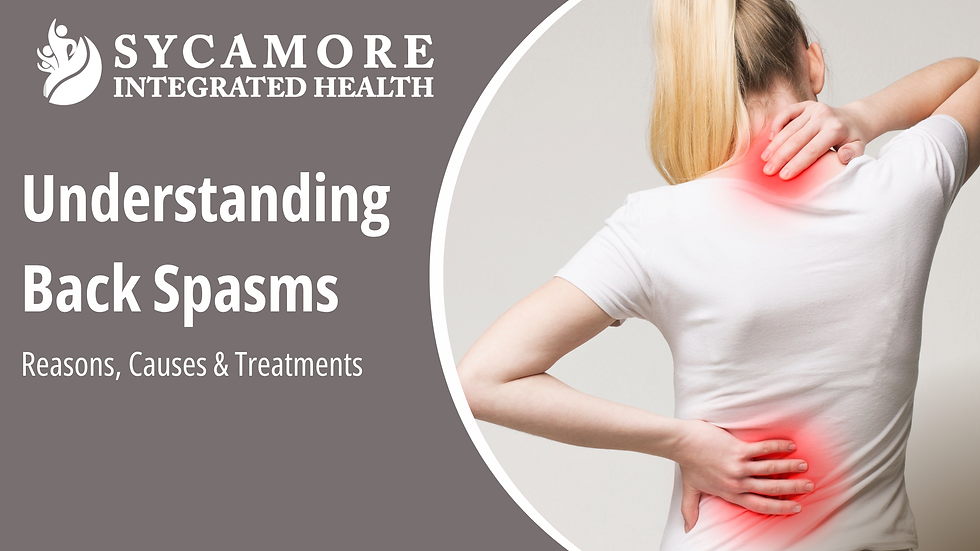
We’ve all been there: you bend over to pick up a load of laundry or twist slightly to reach for the remote, play too much golf, or, embarrassingly enough, cough or sneeze – and suddenly, your back locks up in a wave of intense, involuntary pain. A back spasm!
It can feel like you've been punched in your spine, leaving you breathless and immobile.
But while they are incredibly frustrating, spasms aren't just "malfunctions." They are actually a sophisticated (albeit painful) survival mechanism.
So, what exactly is happening?
If we’re being technical, a spasm is just your muscles deciding to contract without your “permission.”
Usually, your brain is in total control, sending a signal to contract and another to relax. But during one of these episodes, the muscle fibers fire off simultaneously and simply refuse to let go. You’re left with a rock-hard knot of tissue that squeezes nearby nerves and chokes off blood flow – the perfect recipe for that sharp, breathtaking pain that radiates through your back.
But think of a spasm as your body’s version of a neck or back brace. When the brain detects potential instability or injury—such as a bulging disc or a sprain/strain of the muscle or ligament—it sends an SOS to the surrounding muscles.
Why, you ask? Well…
The Goal: To immobilize the joint.
The Method: By locking the muscles into a rigid state (a spasm), the body prevents you from moving in a way that could cause further structural damage.
The Result: Your hips or spine become "frozen" to protect the spinal cord and vital nerves.
Now, while the intent of that spasm is to protect, the trigger can vary.
The most common reason is MUSCLE STRAIN. This is overstretching or tearing a muscle (common in the lower back/pelvis).
Next is STRUCTURAL ISSUES. Degenerative disc disease or herniated discs irritate the nerves, triggering a "lockdown" response.
Third in line is POOR POSTURE/FATIGUE. Weak core muscles or sitting for 8+ hours puts constant "micro-stress" on the hips. This causes spasms in order to stabilize the back.
Up next is DEHYDRATION & ELECTROLYTE IMBALANCES. Muscles require water and electrolytes to facilitate the "relax" signal. When lacking, the muscles will not facilitate proper responses as well.
Finally, ANXIETY & STRESS. Physical tension can manifest as chronic muscle guarding, especially in the pelvic floor and lower back.
So, what do we do for treatment?
Chiropractic Care – If a joint in the spine, pelvis, or hip is restricted or "stuck," the brain stays on high alert. A chiropractic adjustment can help restore proper motion to the joint, essentially signaling to the nervous system that it's safe to let the surrounding muscles relax.
Heat & Ice – Think of ice as the "fire extinguisher" for acute inflammation and heat as the "peace treaty" for tight muscles. Use ice in the first 48 hours to numb the pain, then switch to heat to encourage blood flow and coax those stubborn fibers into softening. After a day or two, we can do contrast therapy – heat the area for 5 minutes, then immediately ice the area for 5 minutes. Perform 2-3 sets of this rotation.
Physical Therapy & Rehab Exercises – Spasms often happen because certain muscles are overworking to cover for "lazy" neighbors. Physical therapy identifies those weak spots—usually in the glutes or deep core—and trains them to do their fair share, so your back doesn't have to go into emergency lockdown mode.
Laser Therapy –This is like a "biological recharge" for your cells. Using specific wavelengths of light (infrared and near infrared), laser therapy penetrates deep into the tissue to speed up cellular repair and reduce inflammation, helping the muscle fibers recover from the exhaustion of a prolonged contraction.
Supplementation –Your muscles are chemically driven engines. If you're low on Magnesium (the "relaxation mineral"), Potassium, or Calcium, the electrical signals in your muscles can get "glitchy," leading to cramps and spasms. Also, there are other supplements, such as white willow bark & turmeric and black pepper, that can naturally decrease inflammation and pain. Proper supplementation ensures your internal wiring has the fuel it needs to shut off correctly.
If you experience spasms, don’t just mask the pain with over-the-counter medications or pain patches—listen to the signal. By addressing the root cause through professional care such as chiropractic, proper movement patterns, hydration, and supplementation, you can alleviate acute spasms and eliminate chronic spasms.



Comments